Delivering Blue Carbon Strategy
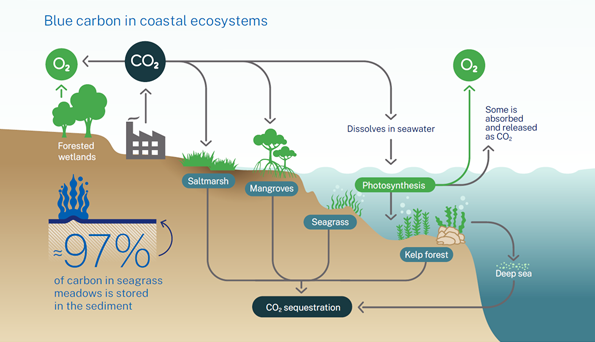 A conceptual model of carbon cycling and storage in coastal ecosystems, known as “blue carbon”.
Overview
This project has been renamed from Developing and delivering blue carbon policy to Delivering blue carbon policy. This is to better reflect the next stage of implementation.
What is Blue Carbon
Blue carbon is the term used to describe the carbon captured and stored by marine and coastal ecosystems.
Blue carbon ecosystems, which include seagrass, mangroves and saltmarsh, can store substantially more carbon per area than land-based forests and, if undisturbed, can store this carbon in soils for many years.
Projects that restore blue carbon ecosystems, such as the reintroduction of tidal flows to restore coastal wetlands, can help deliver significant emissions reductions and may enable carbon credits to be earned.
Why is this project important?
Blue carbon ecosystems, like mangroves and saltmarshes are the world’s most efficient places to capture and store carbon.
Studies have found they can sequester two to four times more carbon per hectare and store it up to 30-50 times faster than land-based forests.
In addition to emissions reduction, blue carbon ecosystems also:
- improve water quality
- protect our coasts from erosion and inundation
- are a key breeding habitat for commercial and recreational fishes.
However, we are losing these ecosystems.
Since European settlement across Australia, we have lost approximately 50% of saltmarshes, 52 to 78% of mangroves and 20 to 26% of seagrass meadows.
Recognising the benefits of blue carbon ecosystems, the NSW Government is taking action to conserve blue carbon ecosystems and support projects that help restore these habitats.
What are we doing?
The NSW Blue Carbon Strategy 2022-2027, developed under this project is a roadmap guiding the development of blue carbon projects in New South Wales.
It uses evidence-based projects and research to conserve and restore important blue carbon ecosystems, and in doing so, increase carbon capture.
The strategy aims to provide the catalyst for action, increase participation in the emerging blue carbon market, and achieve a range of co-benefits associated with the restoration of coastal ecosystems such as improved water quality, coastal protection and enhanced habitat for fish and birds.
The strategy identifies 5 overarching priorities and the actions the NSW Government will deliver under each priority, including:
- Conserving blue carbon ecosystems and supporting their adaptation and migration
- Delivering blue carbon projects on public, private and First Nations peoples-owned and managed land
- Embedding blue carbon in coastal and marine policy planning and management
- Progressing blue carbon research
- Promoting blue carbon investment
Implementation of the NSW Blue Carbon strategy continues to progress well. The Strategy objectives and principals are assisting the development of the NSW Nature Strategy and the Landscape Restoration Framework.
Further funding opportunities have been sought to progress additional actions with likely funding achieved to progress additional demonstration sites. Work to develop the NSW Blue Carbon Strategy Research Prospectus was finalised with work to publish underway.
You can find out more about the Blue Carbon Strategy and related projects at https://www.environment.nsw.gov.au/topics/water/coasts/blue-carbon-strategy
Lead agency
Department of Climate Change, Energy, the Environment and Water (DCCEEW)
Partners
Department of Primary Industries and Regional Development, Department of Climate Change, Energy, the Environment and Water, Local Government, Local Aboriginal Land Councils, Universities and research organisations.